
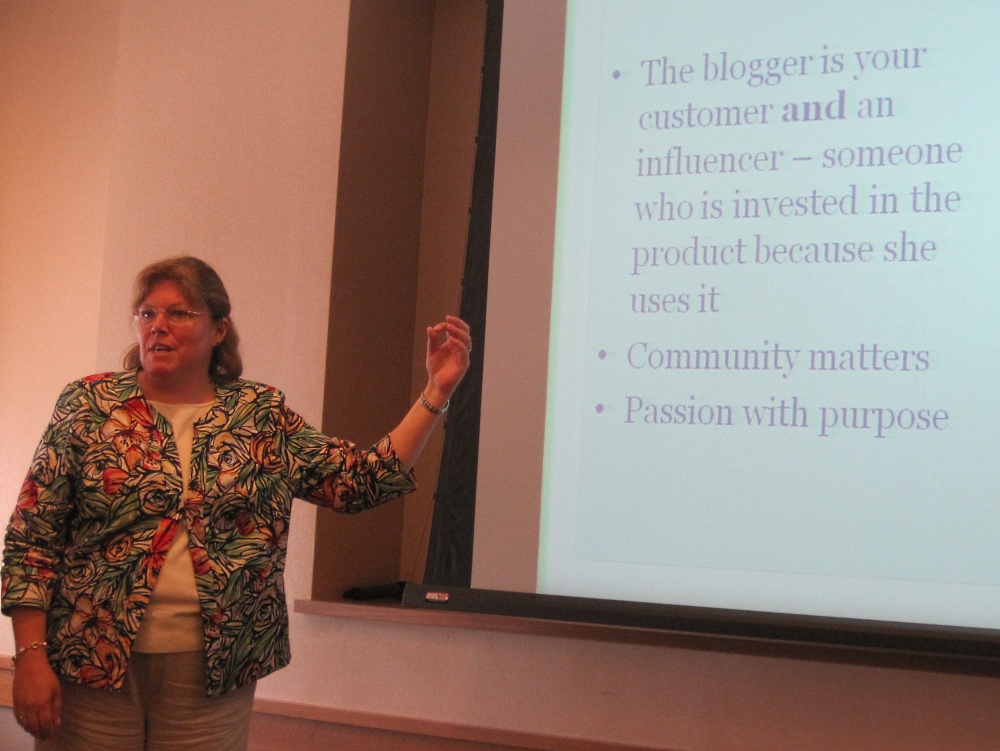
Susan Getgood of BlogHer
Susan Getgood, VP of Sales & Marketing at BlogHer and author of Professional Blogging for Dummies was another speaker at the The Tri-State District of the Public Relations Society of America Innovation Conference which also featured companies such as the NBA and Johnson & Johnson. With most of the audience in attendance being public relations professionals, Susan provided advice on best methods to approaching bloggers and getting coverage for their clients.
Susan stated that even though Facebook and Twitter have grown in size and popularity, content and conversation happens on blogs. Facebook, LinkedIn and Twitter connect networks of people back to the stories on blogs. Everybody is reading blogs, and blogs are about telling stories. Blogs matter to brands because people buy products from what they read on those blogs.
Some stats:
– Seventy percent of blog readers trust the things they read on the internet more than what they would read on a company website or in a magazine. Users read blogs to learn about new products.
– Eighty-five percent of those readers have bought a product based on a recommendation they read on a blog.
We (as consumers) do not like insurance agencies, but Susan described how Liberty Mutual invited a group of bloggers to attend an event held at Ellis Island. A Senior Vice President from Liberty Mutual gave the bloggers details about the Liberty Mutual Responsibility Project and how he spent time with the bloggers for the entire day getting to know the bloggers.
Susan has an interesting blog called Marketing Roadmaps where she provides tips on the best ways to reach bloggers such as:
– Do your research on each blogger and the specific topics covered.
– Develop a relationship and don’t just send out email pitches.
You should include a Blog with Integrity Badge seal on your blog to avoid any confusion about a blog that may be sponsored content; there needs to be disclosure if someone is compensated. There is nothing wrong with sponsored content as it can be engaging and fun if the stories are good, and readers will spread the good stories.
Some examples of the bad pitches Susan has received can be read here.
Which bloggers and websites does Susan follow? BlogHer, Mom101 and PR Squared.
You can follow Susan on Twitter.
You may also be interested in these posts:
Allison Fine and Beth Kanter The Networked Nonprofit: Connecting with Social Media to Drive Change
Gary Vaynerchuk and The Thank You Economy
Gary Vaynerchuk and Robert Scoble Discuss Business and Social Media
Ray Jordan on Johnson & Johnson’s Social Media Strategy
JetBlue’s Social Media Strategy with Jenny Dervin
David Meerman Scott, Author of Real-Time Marketing and PR
John Jantsch, author of Duct Tape Marketing and The Referral Engine


Gary Vaynerchuk and Robert Scoble spoke at the NYXPO.
I attended the NYXPO on Wednesday, October 20 and was pleasantly surprised to learn that Gary Vaynerchuk and Robert Scoble had been added to the event at the last minute. The NYXPO is a B2B networking conference that features educational seminars and exhibits packed with hundreds of business products and services.
Gary Vaynerchuk offered savvy business advice incorporating various social media strategies and Robert Scoble shared his views on what businesses are doing with mobile apps.
Below is the video in three segments and transcript if you do not want to watch the video.
In video segment three we count the number of times Gary curses.
Video Segment 1 transcript:
-Introduction of Gary and Robert.
GARY asks: What do you say will be the most important trend of 2011?
ROBERT
– I talked to the CIO of Starbucks and he says, mobile, mobile, mobile.
– I talked to Sephora.com and she says, mobile, mobile, mobile.
– I talked to Zagats founders and they say mobile, mobile, mobile.
– Starbucks has mobile trends going up every month.
– I can now edit videos on my iphone.
GARY asks crowd: How many have created websites that are mobile friendly? (have an app or .mobi website formatted for smartphone – About five people have raised their hands.)
– Mobile makes it very convenient to do things.
– We have been making all VaynerMedia properties coding for last six months Android apps and friendly in mobile devices.
ROBERT
– Make your business API.
– How many have heard of OpenTable? It is an API that shares if a table is open to reserve in a restaurant. You can get that table reserved through the API.
GARY
– Raise your hand if you ever said: “I will never have a Facebook account; Why would I do that?” How many of you folks said that, and how many of you now have a Facebook account?
– How many people said: “I am not getting a cell phone.” Of those people, who does not still have a cell phone? (Two people raise their hands).
Video Segment 2
GARY
– Here is what I focus on. Here is what I think you should be paying attention to your business.
– I grew Wine Library from a $3 million to a $60 million wine business because I launched Wine Library in 1997.
– I started collecting emails, started a web show.
– The thing I pay attention to every day is: What do people say they are not going to do, when I know they are going to do it.
Gary asks: How many people here think that Foursquare is stupid? He explains Foursquare (you check in wherever you go).
– Why in the world should I checkin through Foursquare? I don’t know, when you go to a bar and check in, and Budweiser gives you a free beer, you will be checking in from now on!
ROBERT
– Starbucks just made a deal with Foursquare. You can see something about the neigborhood you are in.
– Robert has 300 apps on his phone.
GARY
– It has been fifteen years since AOL has spammed us with their discs.
– Gary asks: How many people do not remember the world pre-internet? Internet is evolving so quickly.
– Google is vulnerable in search because Facebook and Gravity have become competitors to Google.
– We would rather have context about who is giving me the information we are seeking.
– My friends would rather get their wine recommendation from me and my information rather than someone that did a good job of SEO on Google.
ROBERT
– I just spent $700 on wine that I did not taste. (He tells story behind it) Shanna Ray is San Raphael invited him to speak at a conference and he saw that she was a connector and she told him to try the winery that was located in an industrial park but they have the only wine on tap in the US. Gary’s tweet back to Robert verified the place he visited had context and credibility.
GARY
– Context is God. Context matters so much more.
– Your business should be on Twitter.
– When someone talks about your business, and you say thank you, LOL, or wink at them, you have now changed the relationship from total stranger to semi-acquaintance.
– After more exchanges, you continue to build a relationship.
– I have a new book coming out in March, The Thank You Economy, that talks about what is the ROI of giving a f***.
– Amazon bought Zappos out of fear.
– Everyone is buying something for more money, and they know it.
– When you see a friend you connect on Facebook and they talk about, “I love Lexus.” That statement impacts you since word of mouth closes in business.
Video segment 3 transcript
GARY
Gary asks, “How many people think Twitter is stupid?”
– Anything that gets 160 million users overnight, even if you think it is stupid, you need to pay attention to.
– People are using it. If there are eyeballs and ears in a platform, you should care.
– His new book opens with quotes of people at the time when television and radio was invented, they were putting down these new technologies and why it is idiotic and tv has no commercial appeal.
– We are creating more content in 48 hours as human beings than we did from the beginning of time until 2003.
– 3500 text messages were sent by teens.
– Phones are not even being used to make calls.
– If you are not using Twitter and trying to figure out how to help your business, you are an a******.
– This is business, not your opinion.
– When five hundred million people are using Facebook, there is sh** going on there.
– Facebook, Twitter, YouTube are tools. You have to know how to use them.
ROBERT
– If you are a restaurant and you are not on Foursquare, you will look lame.
GARY
– You are losing customers to your competition.
– I have more people that watch my wine show every day than subscribe to The Wine Spectator or Robert Parker’s Wine Advocate. These publications have been in business for more than twenty years.
– Yelp is worth more than Zagat.
– Gary asks, “How many know about Yelp, and how many know about Zagat? (More hands go up for Zagat).
– Zagat has a brand equity, but relevance is dwindling away.
– If you are not playing where the people are, you are going to lose.
– I always hear, “Gary you are a younger guy, I did not grow up with this stuff.” You did not grow up driving a car, but you figured it out. It is not an age thing, but a mentality thing.
You can follow Gary Vaynerchuk on Twitter @garyvee.
You can follow Robert Scoble on Twitter @Scobleizer.
You may also be interested in these posts:
Allison Fine and Beth Kanter The Networked Nonprofit: Connecting with Social Media to Drive Change
Gary Vaynerchuk and The Thank You Economy
Gary Vaynerchuk and Robert Scoble Discuss Business and Social Media
Ray Jordan on Johnson & Johnson’s Social Media Strategy
JetBlue’s Social Media Strategy with Jenny Dervin
David Meerman Scott, Author of Real-Time Marketing and PR
John Jantsch, author of Duct Tape Marketing and The Referral Engine
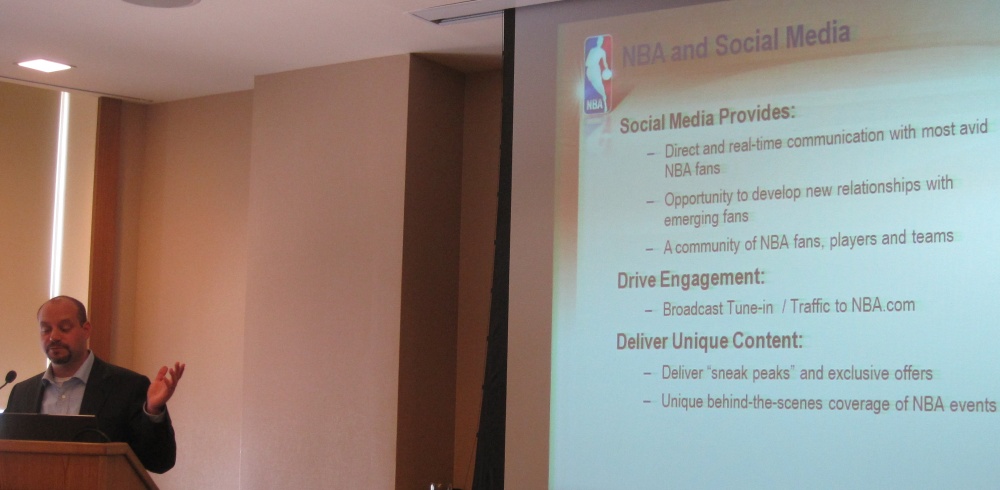
Michael Bass, Sr. VP Marketing/Communications of the National Basketball Association
Michael Bass, Senior Vice President of Marketing Communications at the National Basketball Association provided insight on the NBA’s social media strategy reaching out to fans through Twitter, Facebook, and YouTube as well as the growing digital mobile landscape.
Michael stated that content is king and everything extends from the game and the players. Video is what NBA fans crave so the NBA has created a direct connection with fans by providing a forum to comment and share with each other. The NBA wants to be where the fans are: Facebook, Twitter, and YouTube.
The NBA got involved when Facebook was a college only network in 2008. When the NBA was about to hit two million Facebook fans they devised a unique strategy thanking their fans for growing that Facebook community. Five players were selected to acknowledge various fans through short video clips. Michael played one video clip that featured Dwight Howard thanking Dianne Perez for being fan #1,885,410.
Twitter offers many opportunities for the NBA brand, but enforces some strict rules: During NBA games all players, staff, and National Basketball Association executives cannot tweet forty-five minutes before and during games, and must wait one hour after the game has concluded. Shaq is the most popular athlete on Twitter with over three and a half million followers. Game 7 of the 2010 NBA playoffs between the Boston Celtics and LosAngeles Lakers generated 3,085 tweets per second at the conclusion of the game.
The NBA YouTube channel was created three and a half years ago and is the most viewed channel on YouTube. Video of Detroit Pistons Terrico White at the 2010 NBA Rookie Photo event created great organic coverage when an impromptou slam dunk contest broke out during the event. Word quickly spread of the posted video and twenty-four hours later there were 107,000 downloads on YouTube and 5500 likes on Facebook.
But with all these marketing channels where is the business model for using social media? Monetization – creating sales opportunities for ticket sales and sales to the NBA online store. The NBA partnered with the Dallas Mavericks to hit their fans and engage with their list for the 2010 NBA All Star Game held at Cowboy Stadium. Exclusive ticket packages sold out immediately resulting in 108,000 fans in attendance (most ever).
Michael concluded his presentation with what the future holds for the NBA and social media:
– Social media is in the toddler stage and still growing so there will be more activity on social media outlets.
– Exploring the mobile space as mobile trends are growing with hardware such as smartphones and iPads, and location based applications such as FourSquare and Gowalla providing location based promotional events where fans can win virtual rewards.
– More fan connection and interaction with sponsored content will enable NBA fans to provide feedback and participate in surveys.
You may also be interested in these posts:
Johnson & Johnson’s Social Media Strategy
How Pfizer, Tiffany and American Express Engage Their Employees
Inside Gatorade’s Social Media Monitoring Hub
JetBlue’s Social Media Strategy
How to Make Effective Videos That Connect With Your Audience
Hashtag Killer Psych USA Network Social Media Strategy
How CNBC, Pepsi, and American Express Harness Mobile Marketing and Commerce
Gary Vaynerchuck Book Discussion Jab Jab Jab Right Hook

What caught my attention during the week of October 4-10 and may be worth your time to read as well?
– The Wall Street Journal October 4 article “Diageo’s New Cocktail: Marketing, TV, Stir“
The movie, “The Truman Show” was not far off the mark depicting a reality show documenting a boy’s life from birth to adulthood and was subsidized by advertisers placing products throughout and enabling those fans and viewers to purchase everything from the clothes to even a replica of the house. Now in 2010 spirits company, Diageo PLC is creating a reality series on BET (Black Entertainment Television), called “Master of the Mix,” bought-and-paid-for content produced by Diageo PLC.
From the article:
“The BET series follows seven disc jockeys competing in music-mixing challenges, with one contestant having his or her record “scratched”—eliminated—at the end of each show. The judge is DJ Kid Capri, and the host is hip-hop producer Just Blaze. The side character is a Latina mixologist named Alex, the face of Smirnoff in the series, who rewards each episode’s survivors with Diageo cocktails, interviews the DJs by the bar and shows viewers how to mix drinks, as opposed to beats.”
– The Wall Street Journal October 4 article, “Fastest Growing PR Stunt: Get Into Guinness Records”
Guinness World Records (yes, part of the book) has opened a division to help companies figure out what records to set to highlight their products and brands. Guinness charges $4,739 for a judge to verify the feat and brainstorming records that remain unbroken. What is the downside?
A quote from Dean Crutchfield:
“If too many companies jump into the Guinness pint glass, there will be a danger of it being overused,” said Dean Crutchfield, chief engagement officer of brand agency Method. If that happens, he said, “the programs won’t give companies a lift; they will be washed out by everyone playing the same game.”
– The Wall Street Journal October 8 article, “Haven’t I Heard That Song Before?”
Recording artists Suzanne Vega, Squeeze, and Carly Simon are taking their old songs that were hits (and still a money maker for their old labels) and re-recording those hit songs so the artists can enjoy the new income. If you go to the online article you can listen to Suzanne Vega’s new recorder version of “Tom’s Diner” which (sorry Suzanne) I still think the 1990 DNA remix version still sounds much better than the 2010 version.

Ray Jordan from Johnson & Johnson
The Tri-State District of the Public Relations Society of America Innovation Conference was held at Columbia University and the first presentation of the day was by Ray Jordan, Corporate Vice President of Public Affairs & Corporate Communications at Johnson & Johnson. How does someone create the social media strategy for a corporation that has many policies and two hundred groups within the corporate structure? Ray provided his own experience with Johnson & Johnson as the road map.
Johnson & Johnson had a seventy-three page internet compliance summary and sixty step compliance checklist within the Johnson & Johnson corporate structure which was far too complicated for anyone to manage, so Ray turned to IBM’s blogging policy as a guide that featured one page and eleven guidelines which encouraged new media engagement by employees.
The social media guidelines for Johnson & Johnson include:
– Social media activities must adhere to Company guidelines
– Have a responsible employee business owner
– Have clear business objectives
– Have a posting policy listed on the website
Ray also created a chart: “Guardrails” which is a streamlined approval process for managing content:

Ray described the evolution of social media at Johnson & Johnson over the last three years:
2006: Debut of Kilmerhouse.com about the history of Johnson & Johnson
2007: Jnjbtw.com was created then went into more individual business units
In August, 2007 Johnson & Johnson issued a lawsuit against the American Red Cross. What was the lawsuit about? Here is an excerpt from the post, “You’re Doing What?!”
It was disappointing to discover in recent months that the American Red Cross had started a campaign to license the trademark to several businesses for commercial purposes on all types of products being sold in many different retail and other commercial outlets. These products include baby mitts, nail clippers, combs, toothbrushes and humidifiers, as well as products that fall within Johnson & Johnson’s longstanding product categories. This action is in direct violation of a Federal statute protecting the mark as well as in violation of our longstanding trademark rights.
I suggest you read the entire post as it is very interesting as not only we hear the corporate side of the story, but Ray personalizes the situation from his perspective dealing with the issue as a public affairs representative of Johnson & Johnson.
An editorial team determines which platform is best to to share and announce any news/information via Twitter, Facebook, health channel, kilmerhouse.com, jnjbtw.com.
Ray concluded his presentation with these through points:
1. Be sure people understand who you are and what you stand for.
2. Do the right things.
3. Be seen doing the right things.
You may also be interested in these posts:
How Pfizer, Tiffany and American Express Engage Their Employees
Inside Gatorade’s Social Media Monitoring Hub
JetBlue’s Social Media Strategy
How to Make Effective Videos That Connect With Your Audience
Hashtag Killer Psych USA Network Social Media Strategy
How CNBC, Pepsi, and American Express Harness Mobile Marketing and Commerce
Gary Vaynerchuck Book Discussion Jab Jab Jab Right Hook
 The Mike Johnson Blog