
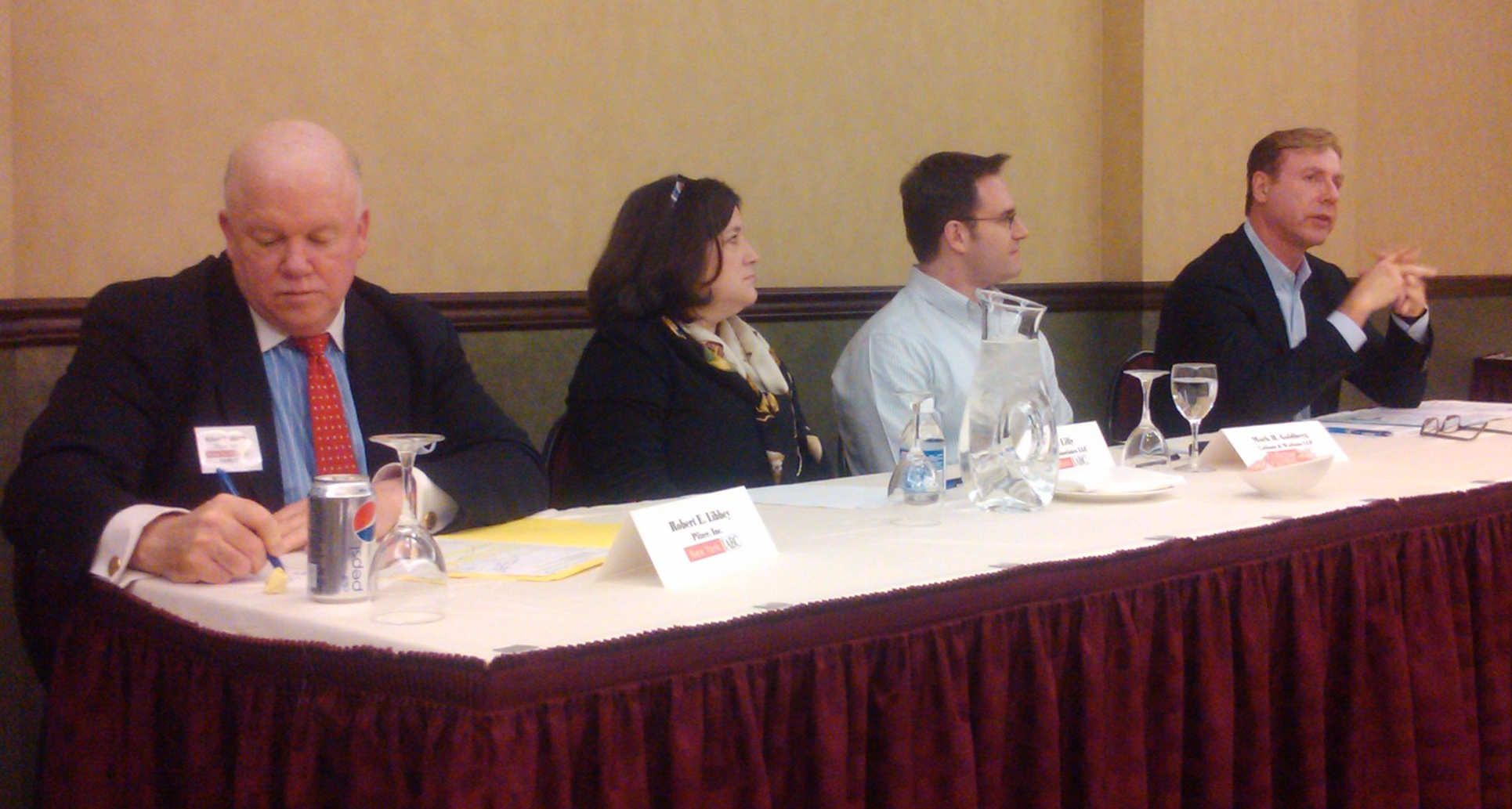
- Panelists for the IABC panel, “Strategies for Information Overload” (left to right) Robert Libbey of Pfizer, Maria Lilly of MJ Lilly Associates, Mark H. Goldberg of Latham & Watkins LLP, and moderator Bob Becton, IABC Vice President and PR Forum Committee.
Does social media help or hurt business communicators in our information overload world? “Strategies for Information Overload” was the topic at the International Association of Business Communicators – New York Chapter on March 11 and sought to “address the overwhelming amount of information coming into a communications professional’s “inbox” and focus on how to best assess what is important, and what is not.” The panelists provided their tips for dealing with information overload and how business communicators can implement them into their organization’s social media strategies.
Panelists included:
- Mark H. Goldberg, Esq. Manager of Internal Communications Latham & Watkins LLP
- Robert E. Libbey, Senior Director-Global Colleague Communications at Pfizer, Inc.
- Maria Lilly, Principal MJ Lilly Associates LLC
- The moderator was Bob Becton, IABC Vice President and PR Forum Committee
Bob Becton asked the panelists what changes they have seen over the past five years in terms of how information being sent from their organizations is being consumed by those receiving the information?
Rob is seeing more user participation over the past eighteen months. Maria had an interesting question: Where are we getting the information from? Credibility is the most important factor in determining the information that you receive. Maria also added that we are now seeing the demise of newspapers, the rise of social media, and the buzzwords are Facebook, Twitter, LinkedIn, and YouTube. Mark sees a proliferation of hand held devices, and also agreed with Maria that the biggest thing now is a rush to social media.
Bob Libbey addressed Pfizer’s role in the social media space and stated that his department had a chance to redo the Pfizer intranet, and it was based on the ESPN model where content is created once and then pushed through various channels such as print, television, mobile, and internet. Pfizer CEO Jeffrey K. Kindler is an advocate of communicating with colleagues so he put out an invitation for Pfizer employees to contribute to the Pfizer intranet. Those employees contributing content get a byline with their photo and bio at the bottom of their story. His department does the writing and editing for the intranet as well and is distributed to the local regional offices rather than the entire company.
Bob Becton asked how the panelists evaluate the large stream of information: By time, money, or both?
Maria has a sorting process. First would be by relevance: does it advance my business? Does it advance my client? Second would be credibility. Lilley’s process is that he goes over newsclips, but he felt that you need to know what people are talking about, and getting the facts correct. If you get one story wrong, your credibility is affected.
Finally Bob Becton asked if communication and marketing departments should be participating in FourSquare and/or GoogleBuzz?
Mark suggested that you have to ask yourself the following questions: What are you trying to achieve, and what audience are you trying to reach? Maria stated that if she makes a recommendation, she has to defend it, and everyone is evaluating the return on investment in social media but there is also a time consideration. Bob Lilley suggests you should be thinking about the following questions: What is the business purpose? Will it support us?
My takeaway from the event is that in this day and age of Google Reader it is very easy to subscribe to the growing number of newsfeeds and blogs. But you have to wonder if you will be able to process it all and get your work done at the end of the day.
You may also be interested in these posts:
Allison Fine and Beth Kanter The Networked Nonprofit: Connecting with Social Media to Drive Change
Gary Vaynerchuk and The Thank You Economy
Gary Vaynerchuk and Robert Scoble Discuss Business and Social Media
Ray Jordan on Johnson & Johnson’s Social Media Strategy
JetBlue’s Social Media Strategy with Jenny Dervin
David Meerman Scott, Author of Real-Time Marketing and PR
John Jantsch, author of Duct Tape Marketing and The Referral Engine


As per Billboard Magazine, the top five Money Makers for 2009 are:
1. U2 – $108,601,283
2. Bruce Springsteen – $57,619,037
3. Madonna – $47,237,774
4. AC/DC – $43,650,466
5. Britney Spears – $38,885,267
How did Billboard arrive at these figures? According to the magazine:
Billboard’s annual Money Makers ranking is based on the artist’s share of revenue as opposed to total dollars generated by each artist in the ranking. The editors used proprietary data from the Billboard Boxscore archives (concert grosses). Neilsen SoundScan (sales of physical albums, digital albums and digital tracks, and from digital services streaming services such as Rhapsody, Napster, AOL and Yahoo, and ringtones.
What about the other forty-five? You can see the entire list here.

If you are not nice your medicine may tell on you.
In 2000 I worked for a company that provided much of the back end to various cell phone carriers that enabled these carriers to offer their cell phone customers the ability to set up various text alerts to be sent to their phones at specific times of the day. With many of the smartphones being offered today these text alerts seem primitive ten years on. One idea back back then was providing cell phone customers with the ability to have a text message sent to their phone that would remind them to take their daily medication(s). One company has taken this idea further in the March 2, 2010 Wall Street Journal article, “Beep! It’s Your Medicine Nagging.” The container that holds your pills has the ability to inform the user to take the medicine at a specific time. Also, it not only reminds the user but keeps inventory alerting you to get a refill of the prescription before it runs out.
“A new pill-container top called a “GlowCap” is equipped with a wireless transmitter that notifies patients when it’s time to take their medicine.” After that, the device can set off an automated telephone or text message reminder to patients who fail to take their pills. It also can generate email or letters reporting to a family member or doctor how often the medication is taken. “
Click here to read the full article and listen to the automated telephone message.

David Lee Roth, a little older with hair a little shorter, but still an operations expert.
After all this time you thought that Van Halen was such a pampered and entitled rock band to demand only brown M&Ms as part of their performance contract when those same M&Ms actually served a much larger purpose. In the March 2010 edition of Fast Company, Dan Heath and Chip Heath in the article, “Business Advice From Van Halen” further explain that the M&Ms served as a guide for the band and/or manager to determine (in very short time) if the venue read the full contract and correctly followed instructions for the show.
“In its 1980s heyday, the band (Van Halen) became notorious for a clause in its touring contract that demanded a bowl of M&Ms backstage, but with all the brown ones removed. The story is true — confirmed by former lead singer David Lee Roth himself — and it became the perfect, appalling symbol of rock-star-diva behavior.
Get ready to reverse your perception. Van Halen did dozens of shows every year, and at each venue, the band would show up with nine 18-wheelers full of gear. Because of the technical complexity, the band’s standard contract with venues was thick and convoluted — Roth, in his inimitable way, said in his autobiography that it read “like a version of the Chinese Yellow Pages.” A typical “article” in the contract might say, “There will be 15 amperage voltage sockets at 20-foot spaces, evenly, providing 19 amperes.”
Van Halen buried a special clause in the middle of the contract. It was called Article 126. It read, “There will be no brown M&Ms in the backstage area, upon pain of forfeiture of the show, with full compensation.” So when Roth would arrive at a new venue, he’d walk backstage and glance at the M&M bowl. If he saw a brown M&M, he’d demand a line check of the entire production. “Guaranteed you’re going to arrive at a technical error,” he wrote. “They didn’t read the contract…. Sometimes it would threaten to just destroy the whole show.”
In other words, Roth was no diva. He was an operations expert. He couldn’t spend hours every night checking the amperage of each socket. He needed a way to assess quickly whether the stagehands at each venue were paying attention — whether they had read every word of the contract and taken it seriously. In Roth’s world, a brown M&M was the canary in the coal mine.”

It has been said that any publicity, good or bad, is good since you are getting media coverage of your company, organization, or client. But lately Goldman Sachs has been receiving a lot of bad publicity and I don’t think Goldman shareholders care for that coverage. The article, ‘Goldman Lists New ‘Risk’: Bad Press in the March 2, 2010 Wall Street Journal, Goldman Sachs states in its annual report that “adverse publicity” could have “a negative impact on our reputation and on the morale and performance of our employees, which could adversely affect our businesses and results of operations.”
The article continues:
“The unusual disclosure in a 12-page section of “risk factors” ranging from rocky financial markets to natural disasters is the latest sign of Goldman’s whipping-boy status among rivals, lawmakers and angry Americans because of the firm’s giant profits.
Some ways Goldman says it could be hurt by bad publicity:
- Investigations can start ‘regardless of the factual basis for the assertions.’
- Morale and performance of our employees’ could be hurt.
- Such morale damage can ‘seriously harm our businesses.’
Goldman has long viewed its communications department as a risk-related function, meaning executives realize that a misstep in how it deals with the media or an issue could cause unnecessary damage to the company’s brand name.
As criticism of Goldman intensified, the firm has aggressively responded to stories it views as false or exaggerated. But the approach has drawn mixed reviews.”
As we continue through the fallout of the 2008 financial crisis (almost two years later) Goldman Sachs still has the bull’s-eye on them. I bet if Goldman Sachs had the cure for cancer tomorrow, people would still hate them.
 The Mike Johnson Blog