

And you thought jelly only came in a few flavors.
I came across the article, “Too Many Choices: A Problem That Can Paralyze,” from the February 28, 2010 New York Times and unfortunately, I can easily get paralysis by analysis. The whole problem comes down to “an overload of options may actually paralyze people or push them into decisions that are against their own best interest.” This happens to me when I try to be an informed consumer and not only find the best bang for my buck, but a product that will last forever (or at least a few years.) When I start on my journey seeking out information, the next thing I know is that I have spent twenty hours looking at all my options for such items as a laptop, cell phone, digital camera, and digital video camera to name a few things. I even had the same experience that Alina Tugend spent seeking out internet, phone, and cable television service a few years ago when I moved to a new apartment:
“A while back, I spent a great deal of time trying to decide which company should provide our Internet, phone and television cable service. I was looking at only two alternatives, but the options — cost, length of contract, present and future discounts, quality of service — made the decision inordinately difficult. This was not only because I wanted to get the best deal, but because the information from the companies was overly complicated and vague. I suspected that both companies were less interested in my welfare than in getting my money — and I didn’t want to be a sucker. This was a problem partly of choice overload — too many options — but also of poor information.”
Whatever choice I make, I then end up for a weeks after making my decision looking at my other choices to see if I did indeed pass up a better bargain. I am left unsatisfied by my choice that is cited in the article:
“Research also shows that an excess of choices often leads us to be less, not more, satisfied once we actually decide. There’s often that nagging feeling we could have done better.”
My first blog post was about TED videos and one of my recommendations was by Barry Schwartz, that knows the topic of too much choice very well:
“Since, fortunately, most of our decisions are less weighty, one way to tackle the choice problem is to become more comfortable with the idea of “good enough,” said Barry Schwartz, a professor of psychology at Swarthmore College and author of “The Paradox of Choice” (Ecco, 2003). Seeking the perfect choice, even in big decisions like colleges, “is a recipe for misery,” Professor Schwartz said. And even though we now have the capacity, via the Internet, to research choices endlessly, it doesn’t mean we should. When looking, for example, for a new camera or a hotel, Professor Schwartz said, limit yourself to three Web sites.”
Even in this modern age where we can easily put our query into Google, there has to be some limits. I will just have to accept my choice and move on; right after I check one more price…
You can read the full article here.

Terry Mattingly, author of the weekly Scripps-Howard News Service “On Religion” column, spoke to the Religion Communicators Council on February 16 and said that media bias by journalists do exist, and religious communicators need to be prepared to educate those journalists to provide a clear and factual story of your organization and message.
Some points include:
- Provide information about your religious institution for a journalist in the most easy to understand manner. Use material from Sunday School that is so simple a young child can understand. Posting materials that you would hand out to a newcomer also helps the journalist.
- Before you accept an interview know who the reporter actually is and what he writes about. Identify all the good and bad blogs.
- Do not hide. Make a condition of the interview that you will record it either via video and/or audio. Terry recorded an interview and his interviewee also recorded to avoid any incorrect quotes.
Mattingly is the author of Pop Goes Religion: Faith in Popular Culture and runs GetReligion.org.
Besides doing the audio recording of this presentation I also did the recorded via a digital videorecorder as well. This is the first time using the video camera and I will have to get a tripod to keep it steady, and decide on a video software program as I used a trial version of Muvee.
You can listen to the full audio here.
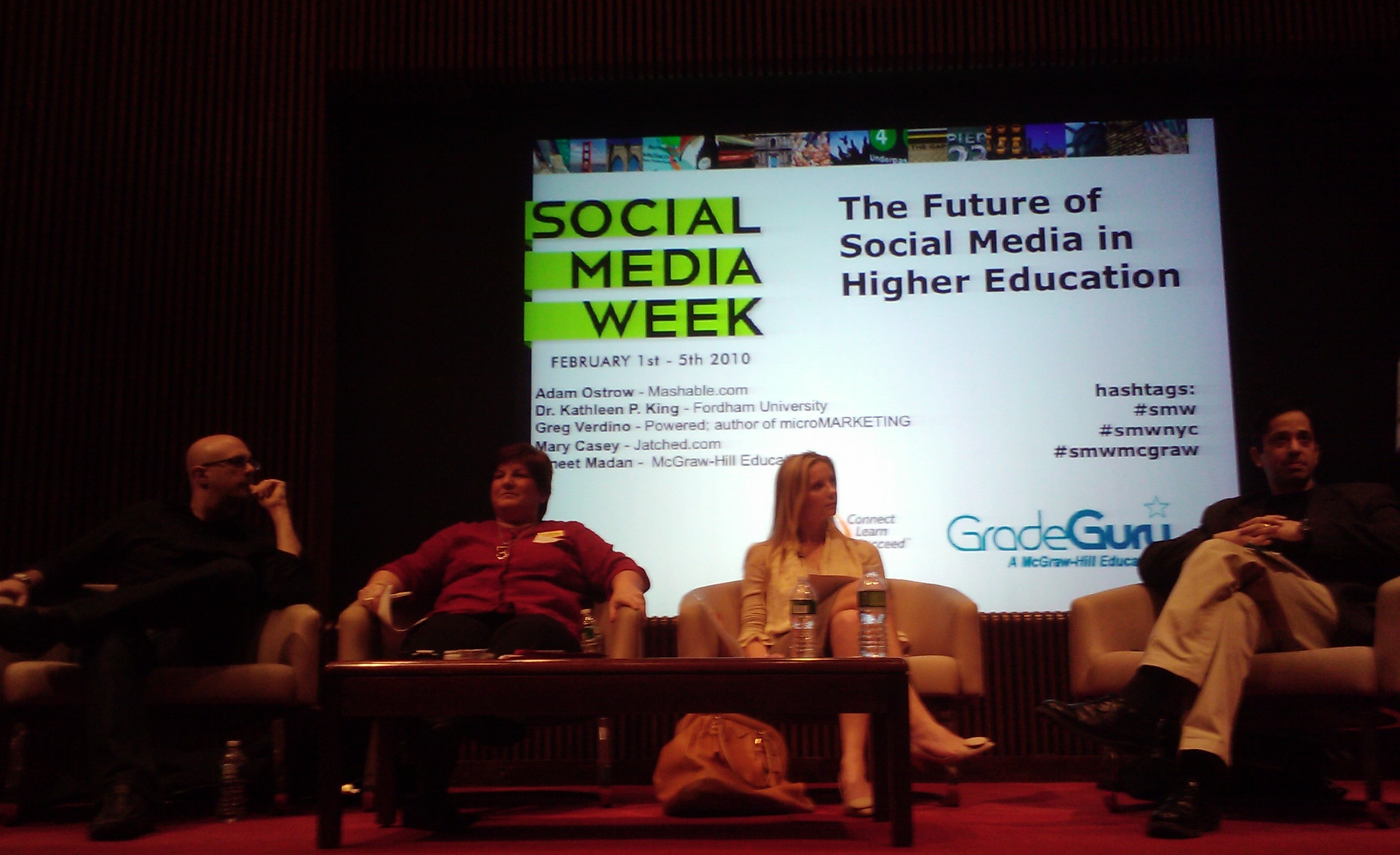
On Friday, February 5 I attended another panel which was part of Social Media Week called, Future of Social Media in Higher Education. Panel attendees included:
- Yianni Garcia, Marketing Specialist at GradeGuru.com (also was the Moderator)
Below is a summary by those on the panel:
Dr. Kathy King
– Community colleges are able to adapt more quickly and respond to the economic crisis offering new programs/certificates on campus and online.
– Distance education is a good connection for social media and provides a platform.
– Need to address needs of non-traditional students (students between the ages of 30-60 that are again returning to school for training during a career transition.)
– Recent demographics show us that these non-traditional students are outnumbering traditional students.
– Faculty has to learn how to connect with students with technology.
– Use Google docs as online learning system.
– Skype used for virtual office hours.
– Working students at jobs can set up a Skype chat and find it to be more comfortable than just talking on the telephone.
– There is no incentive at most universities for faculty to engage students via new technologies. The school needs to make it an incentive for faculty. Excellent teaching means good evaluation at the end of the course.
– How can we use Facebook for professional and education purposes?
Vineet Madan
– There is a lack of engagement getting students into the system.
– How can we use more social media tools to drive the state of learning?
Greg Verdino
– Distance learning university is not using more social media tools.
– Students want to be able to send and receive text messages with dean of students, administration.
– University needs to connect with students as the students connect with themselves.
Mary Casey
– Blackboard has limitations as all your work is deleted after the semester.
– Work of students and faculty is becoming collaborative.
– Students are using Facebook course application and Dropbox.
As with the Healthcare panel during Social Media Week opportunities with education seem to be very promising as well. I believe education will move more quickly with adopting social media practices since the young student demographic is willing to engage in new technology in their daily college life.
You may also be interested in these posts:
Allison Fine and Beth Kanter The Networked Nonprofit: Connecting with Social Media to Drive Change
Gary Vaynerchuk and The Thank You Economy
Gary Vaynerchuk and Robert Scoble Discuss Business and Social Media
Ray Jordan on Johnson & Johnson’s Social Media Strategy
JetBlue’s Social Media Strategy with Jenny Dervin
David Meerman Scott, Author of Real-Time Marketing and PR
John Jantsch, author of Duct Tape Marketing and The Referral Engine
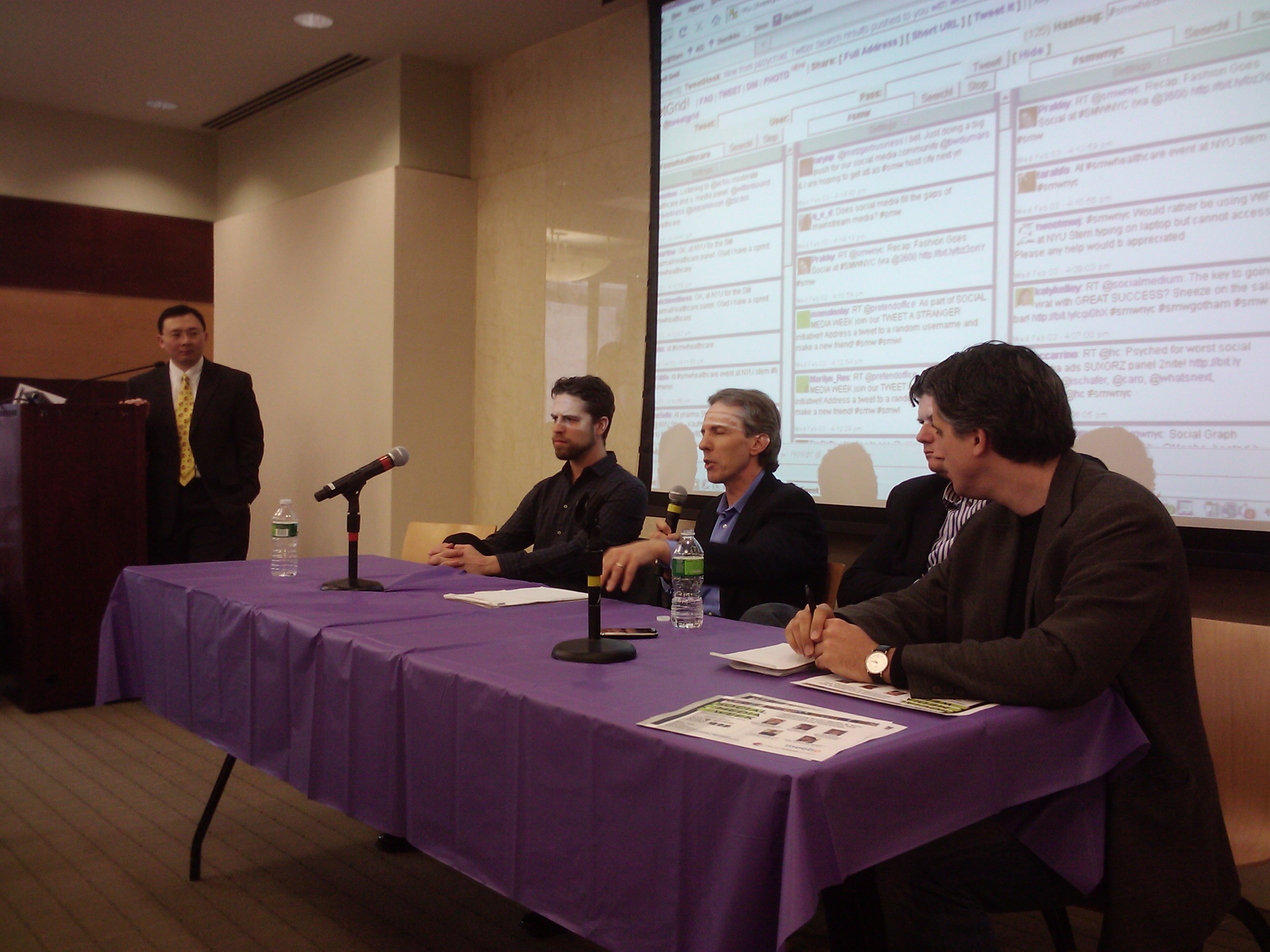
Speakers for the panel, “Navigating Social Media & New Technology in Healthcare & Pharmaceutical Industries” held at New York University during Social Media Week.
“Navigating Social Media & New Technology in Healthcare & Pharmaceutical Industries”, was a panel I attended last month as part of Social Media Week in New York. From the event copy, this panel provides “discussion designed to explore:
– the laws and regulations affecting new technology and social media planning and implementation in healthcare & pharma industries;
– tips for navigating these laws and successfully implementing your strategy;
– and examples of innovative healthcare and pharma companies and what they are up to in the digital world.”
Speakers included:
- Jay Parkinson MD, MPH, Partner, The Future Well / Co-Founder, Hello Health
- DJ Edgerton, CEO, Zemoga
- Oliver Kharraz, MD, COO/ Co-Founder, ZocDoc
- Ned Russell, Managing Director, Saatchi & Saatchi Wellness
DJ Edgerton explained ZocDoc (think OpenTable.com but for setting up an appointment with your doctor, and then providing a review of the visit.) You have to register with the website, and if you saw doctor so they can verify review (if you do not show or canceled, then you cannot leave a review.) DJ also stated that social media provides an opportunity to have a conversation, but there is a fear pharmaceutical companies do not want to have or join in the conversations, especially when there is negative feedback. He also spoke about how ADHD Moms has 10,000 fans that are very involved, and another site MS Lifelines educating people on drugs and treatments. You can follow DJ Edgerton on Twitter at @DJEdgerton.
Oliver Kharraz stated that his country of Denmark has a great health care system, but no real rating system for doctors yet as it is only people who are not happy with bedside manner. He stated simply, “We are focused on serving patients.”
Jay Parkinson stated that paper is very efficient in the office, but a digital records system costs $45,000 upfront costs whether it be a computer system or pda, etc. Even with the high price tag the system is similar to Windows95 in the fact that it looks and feels like you are running Windows 95. Parkinson also states that it is not meaningful data – and technology is not designed to help me do my job well but designed for a billing system. He also felt that lots of drugs are not necessary since a $4 drug has been on market for 20 years and does same thing. In terms of Facebook, he does not want to to friend Lipitor but rather people want to friend people. The real reason that people follow brands? They provide special offers and coupons to purchase. You can follow Jay on Twitter @jayparkinson.
Ned Russell felt that the “I Walk Because” multiple sclerosis campaign provided an excellent forum for those with MS to share information and help themselves. With social media pharmaceutical companies have to deal with the loss of control. But still, measurements are not there yet as benchmarks have not been set as yet. He also added that people want relevant information to help them make informed decisions. You can follow Ned on Twitter @nedrussell.
The role of social media in healthcare looks to be very promising with unlimited opportunity. Now, if only the pharmaceutical companies would be willing to provide more transparency, it can be amazing.
You may also be interested in these posts:
Allison Fine and Beth Kanter The Networked Nonprofit: Connecting with Social Media to Drive Change
Gary Vaynerchuk and The Thank You Economy
Gary Vaynerchuk and Robert Scoble Discuss Business and Social Media
Ray Jordan on Johnson & Johnson’s Social Media Strategy
JetBlue’s Social Media Strategy with Jenny Dervin
David Meerman Scott, Author of Real-Time Marketing and PR
John Jantsch, author of Duct Tape Marketing and The Referral Engine

Seth Godin and Steven Pressfield appeared at Borders Time Warner in New York.
Since I am a Seth Godin fan and attended his presentation at FIT back in January, I was really excited to attend a discussion between Godin and Steven Pressfield, author of The War of Art, The Legend of Bagger Vance, Gates of Fire, Tides of War to name a few. In Seth’s most recent book, Linchpin, he cites Pressfield’s, The War of Art being a big influence. I read the War of Art a few years ago and copied various pages when I need inspiration to get me through any large project that is hitting me with roadblocks. It is a great companion book to Linchpin.
Some of the things covered during the discussion:
– Whatever you are most resistant to, afraid of, that is the thing your soul needs to do.
– Turning Pro – if it is raining outside the pro will go out and train in the rain.
– Call to action is to decide.
– The Resistance will encourage you to do something brave knowing that it will not happen/come true.
– The pain of NOT doing it becomes greater than doing it.
– The resistance gets stronger as you get closer to the goal.
After the discussion was over both authors held a book signing and Mr. Pressfield was gracious to sign a copy for me that I gave to a friend of mine with the hopes that he can win his creative battles.
You may also be interested in these posts:
Allison Fine and Beth Kanter The Networked Nonprofit: Connecting with Social Media to Drive Change
Gary Vaynerchuk and The Thank You Economy
Gary Vaynerchuk and Robert Scoble Discuss Business and Social Media
Ray Jordan on Johnson & Johnson’s Social Media Strategy
JetBlue’s Social Media Strategy with Jenny Dervin
David Meerman Scott, Author of Real-Time Marketing and PR
John Jantsch, author of Duct Tape Marketing and The Referral Engine
 The Mike Johnson Blog