
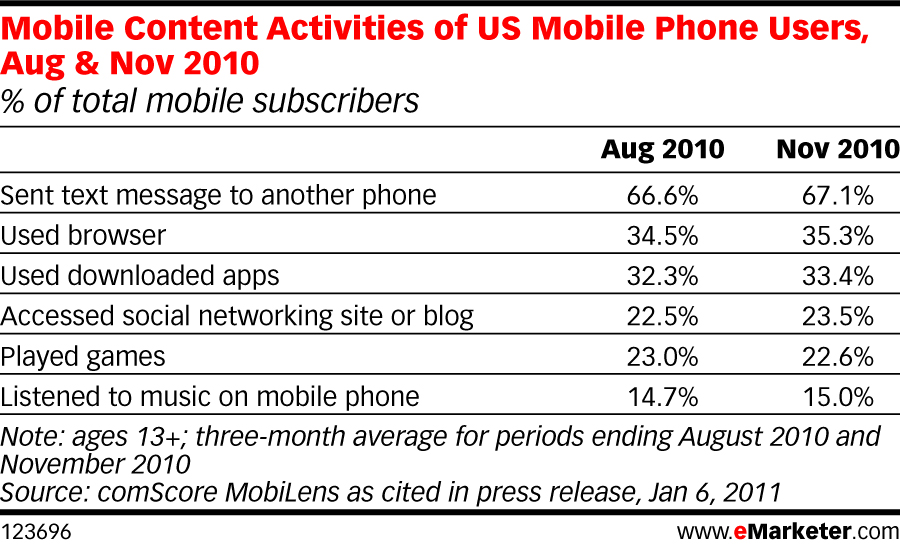
It has been a while but I thought it would be great to update some stats as per a few of my blog readers request. First one up (as per emarketer.com) is Mobile Content Activities of US Mobile phone users.

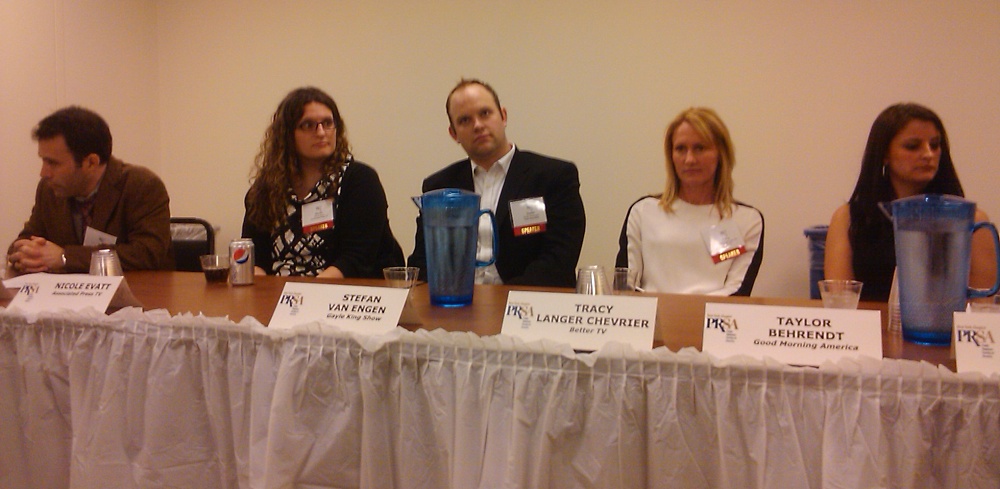
Left to Right: Eric Salzman from The Early Show, Nicole Evatt from Associated Press TV, Stefan Van Engen from Gayle King Show, Tracy Langer Chevrier from Better TV, Taylor Behrendt of Good Morning America.
The March 2011 Public Relations Society New York Chapter brought together five television producers from various broadcast networks providing guidance on what topics/subjects their shows are looking for and how you can get your product, book, movie, story, etc. on to the show.
Panelists:
Taylor Behrendt, Good Morning America
Tracy Langer Chevrier, Better TV
Stefan Van Engen, Gayle King Show
Nicole Evatt, Associated Press TV
Moderator:
Suzanne Lyons, Vice President, Director/Consumer Media at Ketchum
Taylor Behrendt is a producer at Good Morning America and covers news, feature pieces, politics, and health. Since she receives over one thousand e-mails a day, your email will be most effective if you include the subject/person you are pitching in the title and one to two sentences in the body of the e-mail on how you can relate to current events with contact information and person’s bio in the email. A great pitch for Taylor includes what your person/subject can add to the program (hint: something different.) One person that delivered a successful pitch created seven different segment ideas around the theme of the Royal wedding.
Tracy Langer Chevrier is an executive producer at Better TV, a woman’s lifestyle show covering health, fashion, and finance. Segments at Better TV usually feature a doctor speaking about a specific treatment for a disease or ailment and prior to the interview includes real-life personal stories from patients afflicted with that ailment. The best way to reach Tracy is through a short and concise e-mail, and include links showing video(s) of any other media appearances to see how you or your client appears/speaks on camera. Never been on television before? Get out your Flip camera and create one to post on YouTube. And where does Tracy go to find out what viewers are talking about? Facebook is a good place to start.
As a producer for the Gayle King show, Stefan Van Engen overseas all the creative and technical aspects of the show. To get his attention via email construct the email like a magazine/newspaper headline and why would Gayle King be interested in covering your guest/topic. Do your homework (watching the Gayle King show helps) to get an idea of the segments and stories that are covered. A great pitch Stefan received was a segment on prenups March 16, 2011 that had something different to offer. The policy on having paid spokespeople is evaluated on a case by case basis. If Stefan has to sum it all up when deciding on a guest for the show is:
– Is he/she a good talker?
– What can he/she deliver?
– Do you have clips of past appearances?
As a producer for the Early Show Eric Salzman oversees all Washington D.C. content, and rather than receive email, actually enjoys to receive phone calls. A thorough understanding of the show and time segments is important if you want to pitch your person or product. Would the 7:30 a.m. or 7:40 a.m. time fit or is it best as the last segment? Eric also would like to view clips of previous television appearances to get an idea how the person speaks on camera.
Lead times are:
– News segments leadtime is daily
– Health segments leadtime is one to two weeks
– Lifestyle segments leadtime is four to six weeks
And the best pitch Eric received was a suggestion of having President Obama play basketball with Harry Smith.
You can follow Tracy Chevrier on Twitter @bvtracyexecprd.
You can follow Stefan Van Engen on Twitter @stefanvanengen.
You can follow Eric Salzman on Twitter @ericsalzman.
You may also be interested in these posts:
How to Get Your Guest or Book on Rachel Ray, Piers Morgan Tonight, CBS This Morning Saturday
Skills that Get the Guest for Your Television and Radio Show
How to Get Your Sports Story or Guest on ESPN, Boomer and Carton, and USA Today
How to Get Your Story/Event/Guest on Bloomberg News
How to Get Your Story or Event on New York News Shows
Get Your Products and Stories Featured in Mainstream Magazines
How to Reach and Foster Relationships with Mommy Bloggers

Gary Vaynerchuk signing his book, The Thank You Economy
Gary Vaynerchuk has released a new book, The Thank You Economy. I previously caught Gary with Robert Scoble at the NYXPO (which you can view here) and I recorded Gary doing a recent discussion.
Gary talks about:
– How Netflix put Blockbuster out of business
– How Borders gave a big chunk of their business to Amazon
– How people make decisions about business
– Super Bowl advertising is no longer effective
You can follow Gary Vaynerchuk on Twitter @garyvee.
Please note: I was upset to learn after the recording that there is a buzz that came through my recorder and is on the video as well. The setup I use is that I record to my HI-MD minidisc with the audio line going from the audio out (headphones) to the microphone in to my camera. For this event I had to plug in the minidisc power cord as the battery power was very low and I used a cheapo extension cord that was in the power outlet above the room mixer/p.a. power as well. I apologize for the buzz but it is worth watching and listening. Also, if you are having a long wait time to view Part 3, click on HD in the right hand corner.
Part 1
Part 2
Final Segment – If you are having a long wait time to view Part 3, click on HD in the right hand corner.
You may also be interested in these posts:
Allison Fine and Beth Kanter The Networked Nonprofit: Connecting with Social Media to Drive Change
Gary Vaynerchuk and Robert Scoble Discuss Business and Social Media
Ray Jordan on Johnson & Johnson’s Social Media Strategy
JetBlue’s Social Media Strategy with Jenny Dervin
David Meerman Scott, Author of Real-Time Marketing and PR
John Jantsch, author of Duct Tape Marketing and The Referral Engine
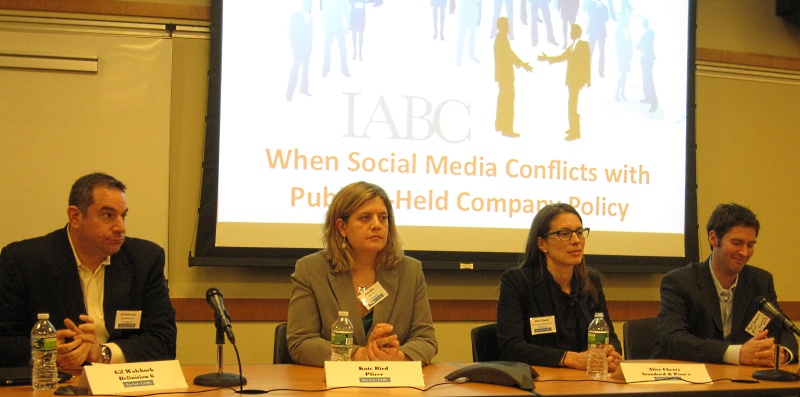
Left to right: Gil Wolchock, Kate Bird, Alice Cherry, Paul Dalessio.
I attended the first 2011 New York chapter of International Association of Business Communicators (IABC) panel of the year (at least for me) called, “When Publicly-Held Companies’ Free-Wheeling Social Media Collides with Disclosure Policies.” The panel had been described as: “When employees disclose “material information” via Social Media, it puts the company in legal jeopardy from a range of potential litigants, including investors, regulatory agencies and even competitors. Unintended disclosures could force an early release or re-statement of earnings, resulting in media barrages, investor calls, and even investigation by the Securities Exchange Commission. How can you minimize the risks of social media while benefitting from its use? Learn from a panel of experts from global, publicly held corporations how to shape your employee communications and disclosure policies to maximize the benefits of social media while minimizing risk.”
- Kate Bird, Director, Corporate Internet Communications from Pfizer
- Alice Cherry , Senior Director Social Media at Standard and Poor’s
- Paul Dalessio, Senior Vice President, Corporate Communications at Fleishman-Hillard Digital for AT&T
- Gil Wolchock, Group Account Director from Definition 6 served as the Moderator
Alice began by telling the story of being approached by her employer in February 2010 to create a social media policy that would protect employees (and the company as well), so she headed up a communications committee that also included the staff lawyers so a friendly language policy could be created. The result: a two-page social media policy explaining what employees could and could not do on Facebook and Twitter.
Kate explained that for social media and pharma there is a natural disconnect, and the industry is waiting for guidance from the Food and Drug Administration for social media guidelines. Pharmaceutical companies cannot discuss their products or allow commentary, and if there are any adverse drug reactions to their products must be reported. Also the one hundred forty character space of Twitter is too limiting for brand building.
For the AT&T brand Paul is constantly interacting with customers, and all customer comments/contributions are monitored on all social media channels twenty-four hours a day, seven days a week. You find those fans and consumers that love what AT&T is doing by communicating with them on a one to one basis. The agency also talks to the AT&T haters and explains AT&T’s position and policy to turn those haters into supporters. Paul also added that Twitter serves as a canary in the coal mine to detect any service outages where customer care can monitor and update to provide customers with any information.
In closing Gil, the moderator asked, “What is the best thing that your organization is doing in the social media realm?”
Paul explained that AT&T had been putting up product information prior to official release but that information was being leaked to websites such as Boy Genius Report and Engadget, so the cat was out of the bag two weeks before announcement. To combat that AT&T would do an unboxed video that enabled fans to get a peek behind the curtain of an upcoming product.
For Alice she spoke about when McGraw-Hill was about publish a book by John Wooden when he suddenly passed away two weeks prior to the release. So the online team launched a social media campaign that drove the community on Facebook and created an awareness of John Wooden and his words, not just marketing.
You can follow Kate Bird on Twitter @katebird.
You can follow Alice Cherry on Twitter @thealicecherry.
You can follow Paul Dalessio on Twitter @pauldalessio.
You can follow Gil Wolchock on Twitter @gilwolchock.
You may also be interested in these posts:
Allison Fine and Beth Kanter The Networked Nonprofit: Connecting with Social Media to Drive Change
Gary Vaynerchuk and The Thank You Economy
Gary Vaynerchuk and Robert Scoble Discuss Business and Social Media
Ray Jordan on Johnson & Johnson’s Social Media Strategy
JetBlue’s Social Media Strategy with Jenny Dervin
David Meerman Scott, Author of Real-Time Marketing and PR
John Jantsch, author of Duct Tape Marketing and The Referral Engine
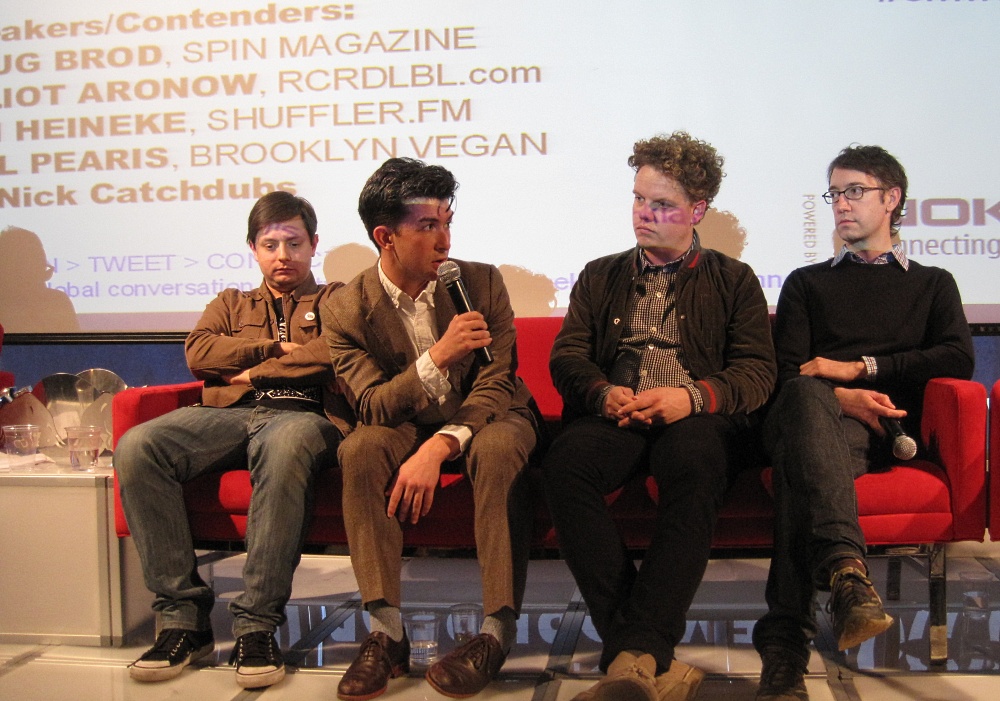
L to R: DJ Nick Catchdubs, Elliot Aronow RCRDLBL, Tim Heineke Shuffler.fm, Bill Pearis, Brooklynvegan.com.
1980 marked the moment of my musical transformation when I was a freshman in high school. I went from listening to AOR (album oriented rock on the FM dial) to seeking out amazing new rock/alternative music that was being broadcast from college radio which expanded my record collection to include The Talking Heads, Gang of Four, The Ramones, Elvis Costello, and The Specials to name a few. College radio was the filter that exposed me to all this new music. So how does someone (with the infinite world of the internet) go about seeking out new music today?
I attended “Guided by Voices… The Changing Face of Music Discovery” during Social Media Week 2011 that featured Doug Brod from SPIN Magazine, Elliot Aronow from RCRD LBL, Tim Heineke from Shuffler.fm, Bill Pearis from music blog Brooklyn Vegan, and DJ Nick Catchdubs. The panel was moderated by Brenna Ehrlich of Mashable.
Doug started off the panel announcing that SPIN magazine will launch an iPad app called SPIN Play offering more than sixty music song streams and original video shot in the SPIN offices such as bands performing live and interviews. This app enables the reader to listen to live and recorded music of the artists they are reading about.
The panelists were asked how they go about finding/discovering new music and Doug replied that he receives a lot of music every week and since there are only six people on the editorial staff it makes it very difficult to listen to it all. Doug also felt that there is no real a and r anymore at record labels so blogs serve in that role. Tim follows music blogs and DJ’s he likes. Bill catches live shows, gets music sent to him and goes to record stores.
When asked how do you find artists in the mass of the internet? Nick replied that no one has time for general interest music. People want someone to say, “This is the best genre of…” or, “Since you like to listen to this artist/band you would probably like…” Nick felt that some music is not supposed to break through as it is designed for the underground. Elliott felt that there is nothing like the older television shows such as 120 minutes or Yo! MTV Raps anymore which served as a taste maker and found things from the underground.
When asked what challenges there are in getting through to people in the digital age Nick replied that when he goes to iTunes he avoids the Feature page as he feels that is an advertisement from labels that simply have purchased the space. Nick craves the character Barry from the movie High Fidelity the music snob record store employee but values his opinion and recommendations for music. Tim frequents a few record stores that provide a trusted source for recommendations as well and he needs a stream of recommendation from people not an algorithm.
So what are the trade-offs finding music by an algorithm versus finding music from people? Elliott replied that having access to everything is not so great. Pitchfork has a recommendation of five things a day which is great for him because you are not hit with one million choices. For Bill he goes to a blog that suggests one band/song a day and is a more personalized filter.
So how has terrestrial radio fared through all this? Nick feels that radio is still the most accessible medium for exposure, but of you are trying to discover something new you better be listening to HOT 97 after 1 a.m. Elliott replied that college radio has been dying but an emerging music space is music blogs.
You can follow Doug Brod on Twitter @DougBrod.
You can follow Elliot Aronow on Twitter @youngelz.
You can follow Tim Heineke on Twitter @timheineke.
You can follow DJ Nick Catchdubs on Twitter @catchdini.
 The Mike Johnson Blog